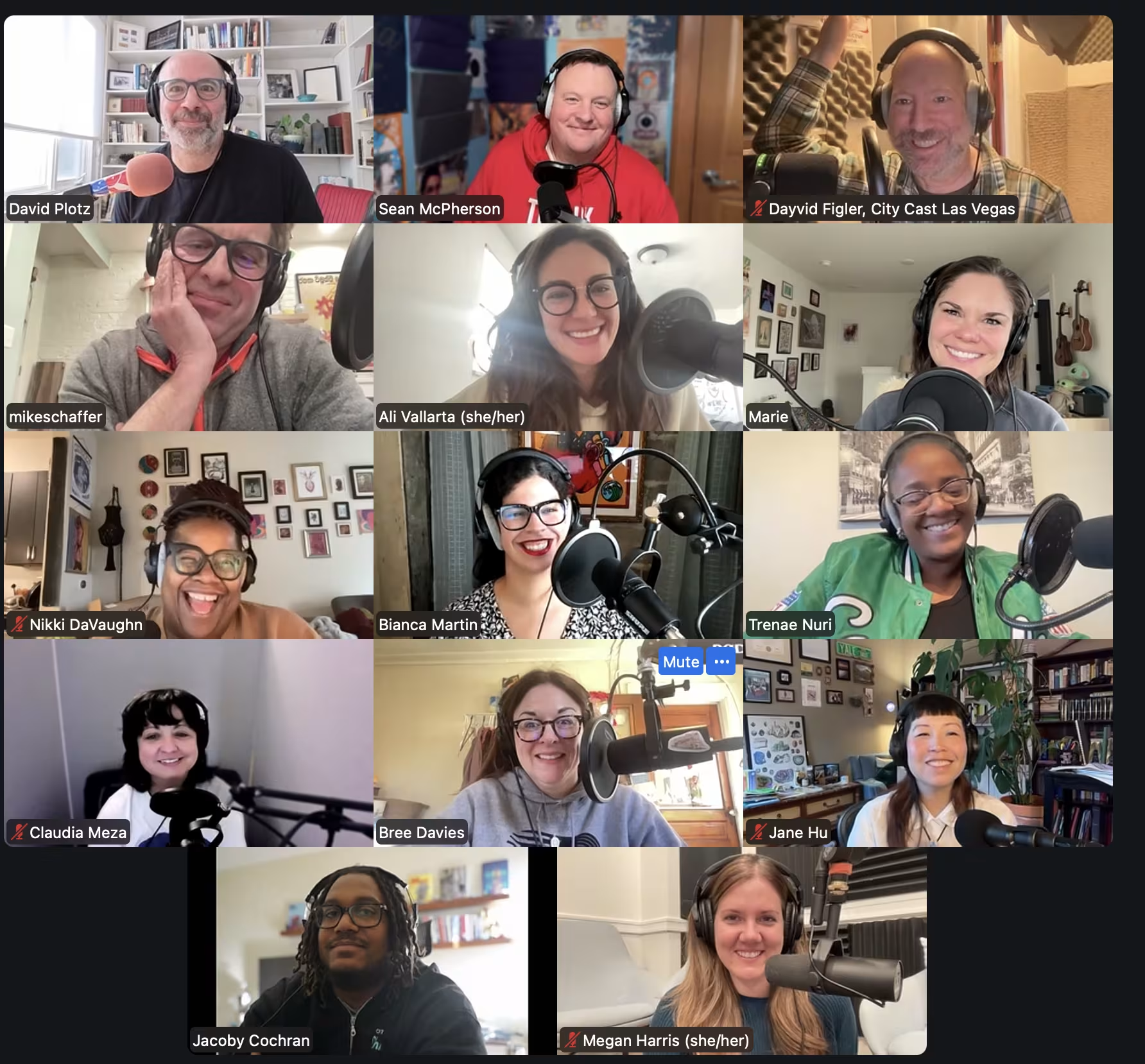

Three of us – Host Sean McPherson, Contributor Denzel Belin of MPR News and I saw the stage adaptation of Prince’s legendary film and album Purple Rain and our takes may be sacrilegious, but we promise they’re from the bottom of our sequined hearts. Hear the full 12-minute review on the City Cast Twin Cities podcast, check out our social video of only the hottest takes, or read on for our analysis.
Sean: Dearly beloved, we gathered Wednesday night at the State Theater together to get through this thing called the “Purple Rain” musical, and this is after three weeks of previews. Purple Rain had its debut and this play of Purple Rain – originally a movie and now a musical – has been in the works for over a half decade, and it featured some heavy hitters from the theater world as well as some relative newcomers.
Some big names include playwright Branden Jacob-Jenkins, who won a Pulitzer Prize, producer Orin Wolf and Tony-nominated Lileana Blain-Cruz, who staged the show. Now all of us have seen the show. Anna and I went to the first non-preview showing, and Denzel, you went to one of the previews. I want to get some quick answers from you all about your experience of seeing this musical and that way we can kind of figure out how we collectively felt about it. Anna, what did you think was the best song performance?
Anna: “Beautiful Ones.” It was the closing of the first act and The Kid, the main character, the sort of Prince-type character, was writhing on the ground. You know, that part where he goes, “Do you want him or do you want me? ‘Cuz I want you!” It almost got a standing ovation in the middle of the play. It was so incredible. I was like, crying.
Sean: I should point out that the middle of the play was about two hours into the play. Denzel, what was your favorite song performance from Purple Rain?
Denzel: “Nasty Girl.” I love that song so much and I was so delighted to see it and it featured Apollonia, who I adored in this showing. One of my favorite songs that Prince wrote.
Sean: Let's move over to worst song performance. Denzel, what do you think was the nadir of the song performances in the show?
Denzel: Anytime there was a weird, sexy dream ballet that wasn't as sexy as you wanted it, but way more ballet than I wanted. It just took me out of it. Beautiful singing all around, but there were some really hot people who weren't quite getting as hot as I'd wanted them to. But sure — giving me full ballet.
Anna: Yeah, every time there was a sex scene, more and more people came onto the stage to have dance sex. And I was like, who are these people? Is this a ménage? I don’t know what's happening.
Sean: The longest sex ballet moment was on “Electric Intercourse,” which is a B-side. It wasn't even on Purple Rain when it was released. It only came out with the deluxe reissue a handful of years ago, and in a show with a lot of head scratchers, that was one of the big head scratchers.
I was really unimpressed with how they used “When Doves Cry,” which is Prince's biggest, highest-charting hit, and the most significant tune from the album. You might say “Purple Rain,” as it's the title track, but in terms of song notoriety, that's the high-water mark. It opened the second half of the show, and it was done up in an “I'm writing the song as I go” way. I thought, this is an opportunity to tear the house down, to get another standing ovation, and they totally blew it.
Best actor to you, Anna?
Anna: Jared Hamilton, who played Morris. I didn't always like what the character was saying — I’ll talk more about this — but he was a really talented comedic actor and he gave it like 400 percent.
Denzel: Morris was a standout. But also the actor who played Jill, the waitress—what a delight. That happens really close to the beginning of the show and got me really hopeful for the rest of the show.
Anna: Yeah!
Sean: I feel like this show suffered from too many cooks in the kitchen, no matter how good each individual cook was. Did either of you get that feeling watching the show? Like, this is no one's singular vision of how to put Purple Rain on stage?
Denzel: I absolutely felt that way. It felt like a lot of people were saying, “You need to accomplish this, you need to accomplish that.” And as someone who has written scripts based on feedback, it can get tricky. It was clear it wasn't just one person's point of view guiding the playwright and book writer. It felt like at least eight or 10 people were trying to “fix” the movie into a musical, and it suffered because they were trying to “fix” so many problems.
Anna: I was actually thinking about you a lot when I was watching the show, Denzel — and our friend Tane Danger too — because the type of comedy you do at the Brave New Workshop, and that you guys do at the Theater of Public Policy, is really top of the intelligence. You're doing comedy about politics and social issues. You pour over these scripts and they go through draft after draft after draft at the workshop. And we were sitting right behind your director Caleb McEwen too at “Purple Rain”.
But this show was so incredibly broad. And we were at opening night — people were in ball gowns and tuxedos. They were ready to have a good time. And some of the jokes that were the most broad — for example, when The Kid is visited by one of his bandmates who's checking up on him. He's just about to leave the room and then he says, “and take a shower,” and everyone bursts out laughing like it's the funniest thing. That is broad comedy.
And sadly, I see a lot of touring Broadway shows come through town that are like that … local references that make people scream and laugh. But would Prince have liked that? No! One of the most special things that's ever happened to Minnesota is Prince. He was unique and above this make-anyone-laugh, lowest-common-denominator style of comedy. I kept seeing it over and over in the show and was really frustrated by that.
Sean: There's a unique dance that “Purple Rain” is a movie with a lot of laughable moments, and also a movie with moments where you go, “That didn’t age well,” and also, “That wasn't that on the nose in 1984 when it came out.” And somehow it all got worse.
One of the things that enthused me about this show — and also bothered me — is that I feel like they rightfully addressed a lot of the misogyny in the show not only by excising it but sometimes flipping it. Instead of Morris Day throwing a woman into a garbage can, you have him singing out of a garbage can.
But they also kind of kid-gloved the domestic violence that's at the center of the movie and made his father a much more likable character, and he was only shown committing acts of violence on film. It seemed like a strange modification of the highs and lows of the movie.
Anna: Yeah, the ping-ponging between scenes of domestic violence and then seeing the father figure as a hero was staggering. I couldn't handle it.
And the treatment of women overall in the show was very frustrating. The number of times women were called “bitches,” not in serious moments but in comedy moments, and the audience would burst out laughing, felt like it put all of womankind back. And Apollonia's big ending, her big success story, was that she does a screen test for a dating show and gets treated poorly in that screen test. That was her big ending. It was very sad.
Denzel: And I think that ending would've landed had they not tried to sanitize other parts of the show. If it were a completely messy story about fame and how it affects people, I think it would've stuck the landing. In fact, that scene felt very much within the world of Branden Jacobs-Jenkins’ work as I know it — like a brutal mirror up to society. But there were so many other moments where it didn’t feel like him, and it didn’t feel like it was serving the musical, other than, “What happens if we tour this to Dubuque, Iowa? How will they respond?”
Overall, I feel like there was so much talent that came together to make this show happen, and this product doesn’t properly showcase everyone at 100 percent. Probably everyone was cranking at 60 or 70 percent, and that’s where the show landed.
I think Kris Kollins as The Kid is a fantastic singer and a fantastic dancer, which was a delight to see. But I feel like the acting responsibility may have been a little out of his realm as the show was written. And I feel like the actor who played Morris was one of the people who fully got to shine. But something felt restrained about the whole product.
Sean: They hid Prince's acting shortcomings in the movie, and they did not hide Kris Kollins' acting shortcomings in the play, and they might've been served to.
We do want to hear from you. Have you seen “Purple Rain?” Do you plan to see “Purple Rain?” Shoot us an email at twincities@citycast.fm and let us know your thoughts.