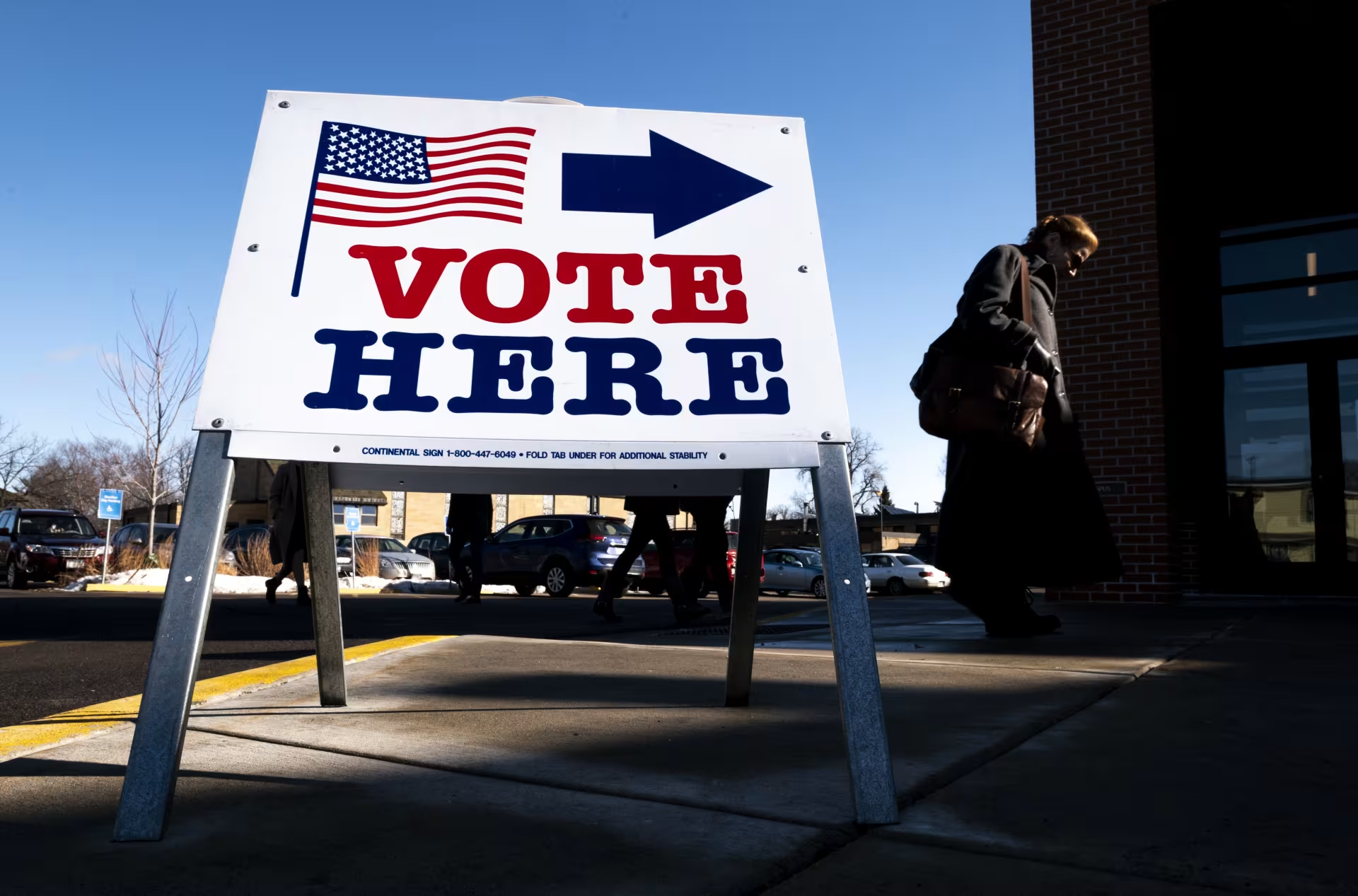
The Minnesota Supreme Court unanimously ruled that USA Powerlifting violated JayCee Cooper’s human rights when it barred her from competing in a local meet. The USAPL told Cooper that transgender female athletes were not allowed to compete in the women’s division “as it is a direct competitive advantage.”
The decision provides legal backing for trans athletes in Minnesota to make claims of discrimination in public accommodations. However, the court left open the door for USAPL to prove it has a “legitimate business purpose" in excluding trans athletes.
We talked to Hannah Wydeven, owner of Solcana Fitness, for more context on the world of powerlifting. Cooper hired Wydeven as her personal trainer in 2018 before she entered the USA Powerlifting meet. Wydeven emphasized that Cooper entered as an amateur powerlifter, meaning she would not have won any financial prize. In fact, amateur contestants have to pay a fee to enter meets.
“ To prevent [a trans athlete] from participating in an amateur meet where they're paying to participate, how can you justify that as a business decision?” Wydeven said.
The decision comes at a time when Republicans across the country are campaigning against trans women and girls’ inclusion in sports. The Trump administration is accusing Minnesota of violating Title IX for allowing trans girls to compete in the division that matches their gender identity. If Minnesota doesn’t change its policies, the administration warns it will withhold federal funds to schools.
You can read a transcript of City Cast’s interview with Hannah Wydeven below. The conversation has been edited for length and clarity.
How are you connected to this story?
Wydeven: I run a gym called Solcana Fitness, and we're a queer and trans inclusive space. And so when JayCee Cooper was first interested in learning how to compete in powerlifting and train in powerlifting, she hired me as her coach, as her personal trainer. And when she was learning how to compete in powerlifting, she decided to enroll in an amateur powerlifting competition – specifically in a bench press-only competition. And that is when this whole issue with the USA Powerlifting Association started, is they rejected her participating in this local competition.
Then, after she was rejected from the competition, USAPL put out a statement – it was a very inflammatory statement, and I'm not going to repeat it here – basically saying they're not allowing trans people to participate in power lifting at all in USA Powerlifting.
And as a response to that, a bunch of athletes from my gym and several other power lifting gyms all got together and performed a protest during the women's state power lifting meet, where essentially, we all signed up to compete in the meet and then instead of actually competing during our minute on the platform we stood and didn't participate, and people held up trans flags. They wore t-shirts that said “trans lifters are welcome”.
Just for context for people, USA Powerlifting is not the only powerlifting federation in the country. There are actually many different powerlifting federations. USA Powerlifting is just the biggest one and has had a big Minnesota local presence.
Do you think USA Powerlifting has a legitimate business purpose in banning trans women from competing in the women's division?
Wydeven: I don't think they have a legitimate business purpose in this regard, because I think what they're trying to say is that “we make money off of these meets and if we can't create a fair playing field, then we can't make money off of our meet as a business”. But prior to this issue with JayCee, the USA Powerlifting had what they called a TUE, a therapeutic use exemption, which is something that's used in the Olympics, that's used in many other large weightlifting federations, powerlifting federations.
And in the TUE, essentially, you submit paperwork about something that you're using that's normally against the rules of the federation. So that could be anything from like a medication that you're using, an androgen that you might be using, or in this case, some hormone therapy, and you demonstrate that you've been using it for a certain amount of time.
And then if you compete and you were to win or place in the top three or set a record, they would do a urine test to make sure that your TUE matched your hormone levels. And that's the case across the board, right? Because they want to make sure that people aren't using other things, like essentially steroids, to help their competition. So that's not out of the norm.
In fact, they had that in place for many, many years. But what we saw is that when someone tried to use the TUE to demonstrate that estrogen levels were at the right level that they had asked for, instead they reverted to say, ”No, this doesn't work anymore. We're not doing this, and what we're going to say instead is [that] this is “high school biology”, and “people should understand that there's just no way for this person to compete.”
But that's not the case in many, many other federations. So they could try to make this argument, but the fact is, there is a way for them to hold business and do it to a certain standard, and it's replicated in many other federations.
Cooper wanted to compete in an amateur powerlifting competition, not a professional one. What’s the difference?
Wydeven: I would say almost all of it is amateur, right? And especially at the local level. People who are competing in these meets are paying to enter them, and they're not winning any financial prizes. I myself have competed in many USA Powerlifting meets. You pay $150, $175 to compete in the meet. And when you win a prize, you don't win a financial prize. You win a medal. That's it. And oftentimes, every time I've won or gotten second place, I haven't been urine tested. Why? Because I'm not setting any sort of state or national records. So, to prevent somebody who has not demonstrated the fact that they're going to potentially break a record to prevent them from participating in an amateur meet where they're paying to participate, how can you justify that as a business decision?
Thank you for providing context to this issue.
Wydeven: I think it's important for the listeners to really think about, is there a place for us to say people can participate in fun athletic activities without meeting these certain standards? Is there a way that we can just allow people to try things and explore things as kids, as adults, and then help them find the route to actually getting to a professional level if that's something they desire, whether they be trans or not? Do we see value in having people participate in sport? I think the answer is yes, personally.